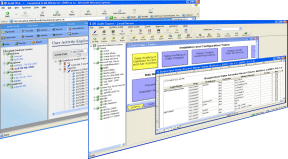
DB Audit and Security 360 v5.0.1.20
for Oracle, SQL Server, DB2, Sybase, and MySQL database servers
Leading Database Auditing, Compliance & Security Solutions
|
| |
Database security & auditing made simple
|
|
|
| DB Audit and Security 360 is an all-in-one professional database security and
auditing solution for Oracle, Sybase, DB2, MySQL and Microsoft SQL Server. DB Audit and Security 360
enables database and system administrators, security administrators, auditors and
operators to track and analyze any database activity including database security, access
and usage, data creation, change or deletion. What makes this solution really unique is its
built-in support for multiple auditing methods giving you the flexibility to choose the
best fit for your database security requirements. Key Benefits
- Improves system security and ensures system accountability. Captures both regular and
"back-door" access to audited database systems.
- Features centralized security and auditing control of multiple database systems from a
single location providing ease of management.
- Features unified auditing graphical interface that shortens the learning curve and is
easy to use.
- Provides analytical reports that reduce large amounts of audit data to comprehensive
summaries thus enabling to easily identify various database security violations.
- Provides analytical reports that help to identify which processes and users are hogging
system resources.
- Provides audit trail details that are unavailable from native database audit utilities.
- Provides ability to generate real-time email alerts to key personnel when changes occur
to sensitive data.
- Frees DBA from the need to create and manage finely-tuned database triggers for
data-change auditing purposes.
- Supports flexibility auditing configurations, enabling security personnel to choose
specific types of database operations and data changes that must be monitored and recorded
in the audit trail.
- Provides totally transparent system-level and data-change auditing of any existing
applications without requiring any changes to be made in those applications.
- Full compatibility with all host Operation Systems on which the supported databases can
run, including but not limited to Windows NT, UNIX, Linux, VMS, OS/390, z/OS.
|
|
|
 |
DB Audit User's Guide
(v5.0)  PDF, 6.5 MB, 369 pages) PDF, 6.5 MB, 369 pages) |
|
|
Support Forum
Ask your questions here. |
|
|
Pricing
and Upgrade Options |
|
|
Other Information
Last version: 5.0.1.20
Release Date: March 5, 2018
Technical specifications:
|
Disk space - 122-211 MB, Memory - 1 GB |
|
GUI Console OS - Windows (x86 platforms) - DB Audit
Management Console |
|
Web Console (multi-platform) - any web server capable of running JSP - DB Audit
Web-based Management Console, Apache Tomcat recommended |
|
Alert Center and central repository (multi-platform) - DB Audit
Alert Center server |
|
Supported database systems:
|
Oracle 10i and later |
|
Microsoft SQL Server 2000 and later |
|
Sybase SQL Server and Sybase Adaptive Server Enterprise 10.x and later |
|
Sybase SQL Anywhere and Adaptive Server Anywhere 6 and later |
|
MySQL 4.2, 5.x |
|
IBM DB2 for Linux, Unix, Windows 7.x and later |
|
IBM DB2 for z/OS and OS/390 6.x and later |
|
IBM DB2 for OS/400 5.x |
|
|
Connections via native database drivers, ODBC, JDBC or OLEDB/ADO |
|